
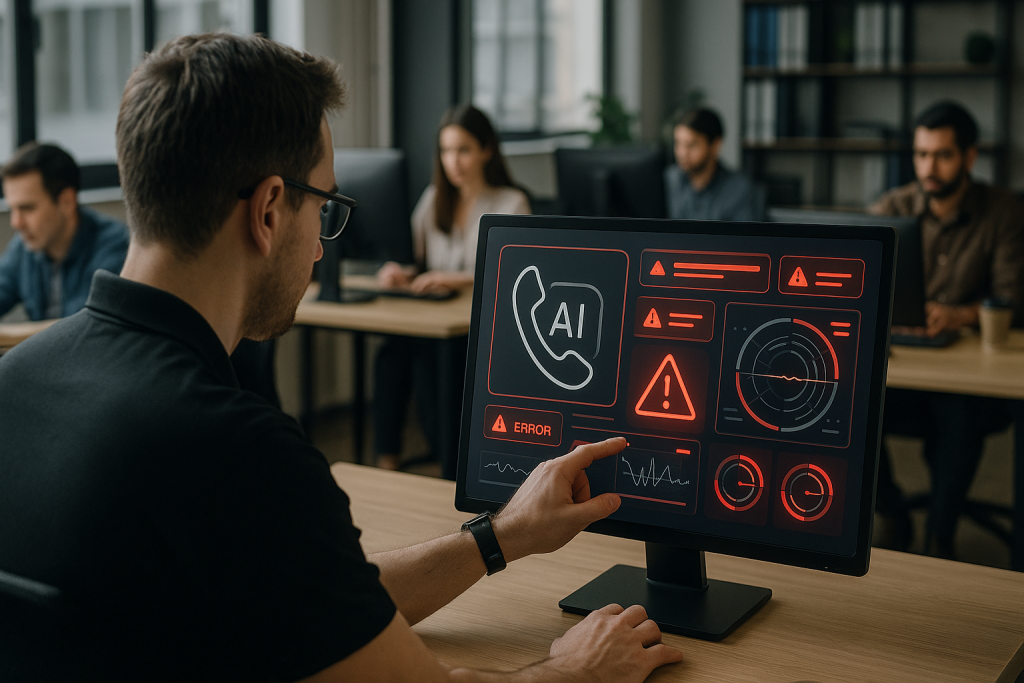
The AI phone answering system has become the unsung hero of modern business communication. For small businesses, startups, and enterprise-level organizations alike, it’s the digital receptionist that never sleeps, never calls in sick, and can handle hundreds of interactions simultaneously. However, just like any technology, even the most advanced system can experience hiccups.
And when it does, it can feel like the entire lifeline of your business communication is at risk. Missed calls, misunderstood customers, or robotic-sounding conversations don’t just hurt your workflow—they chip away at customer trust. That’s why understanding the most common issues with an AI phone answering system—and knowing how to fix them—isn’t optional; it’s essential.
At Smart Business Phone, we’ve seen firsthand how organizations either thrive with AI-driven communication or struggle when they lack effective management of it. Let’s break down the real-world issues professionals like you face and the actionable fixes to get your AI phone answering system back on track.
Key Takeaways
- An AI phone answering system is essential for modern businesses but often runs into issues like poor call routing, robotic responses, and misunderstood customer input.
- The biggest frustrations for customers usually come from overly complex menus, integration breakdowns, and lack of personalization.
- Regular audits, staff training, and system updates are the best ways to keep your AI phone answering system efficient and frustration-free.
- Failover planning and redundancy are critical—your phone system should never go down without a backup plan.
- With the right provider, like Smart Business Phone, businesses can turn their AI phone answering system into a competitive advantage that feels seamless and human.
1. Call Routing Confusion: When AI Gets It Wrong
One of the most frustrating problems businesses encounter is when their AI phone answering system sends calls to the wrong department—or worse, drops them entirely. This isn’t just an inconvenience; it creates a negative first impression that can cost you leads.
Why it happens:
- Poorly mapped call flows.
- Overcomplicated menu structures.
- Lack of updated directory information.
Audit your call routing structure quarterly. A streamlined flow should mimic how a real receptionist would think—simple, direct, and human-like. Smart Business Phone recommends role-based routing with conversational prompts like “Would you like to speak to billing, customer care, or technical support?” instead of long numeric menus.
2. Robotic or Impersonal Responses
Ever called a business and felt like you were speaking to a cold, monotone robot? That’s a classic AI phone answering system problem. Customers don’t want to feel like a ticket number—they want to feel like they matter.
Why it happens:
- Outdated voice synthesis engines.
- Lack of natural language processing (NLP) optimization.
- Generic, canned responses.
Modernize your system with conversational AI tuned to your brand voice. At Smart Business Phone, we integrate AI that learns over time, adapts its tone, and even mirrors natural pauses to feel more human. Adding small touches—like greetings customized with time of day—dramatically changes customer perception.
3. Misunderstood Customer Input
If your AI phone answering system constantly misunderstands callers—mixing up “sales” with “support”—the frustration builds fast. In some industries, that misunderstanding can even mean losing a deal on the spot.
Why it happens:
- Weak speech recognition training.
- Too much background noise in calls.
- Limited vocabulary models.
Train your system with industry-specific terms. A healthcare provider’s AI should recognize “pre-authorization” just as smoothly as “appointment.” Smart Business Phone uses adaptive language modeling that evolves with your customer interactions. Pro tip: encourage callers with simple instructions like, “Please say ‘billing’ or ‘support’ clearly.” It reduces errors by over 20%.
4. Overcomplicated Menus and Endless Loops
Nothing drives callers away faster than an AI phone answering system that feels like a maze. If customers are forced to press 1, then 2, then 3, only to be looped back, they’ll hang up and never call again.
Why it happens:
- Trying to cram every department into the phone tree.
- Failure to prioritize high-demand options.
- Outdated workflows that no one audits.
The golden rule: fewer than four options per menu. Every second of call friction costs you. Smart Business Phone designs systems with intelligent intent recognition, which means your caller can just say “I need billing help” and get there directly—no endless menus required.
5. Integration Breakdowns with Other Tools
An AI phone answering system isn’t supposed to live in isolation. It should connect seamlessly with your CRM, ticketing platforms, and scheduling tools. When integrations break, agents lose context, and customers get annoyed repeating themselves.
Why it happens:
- Outdated APIs.
- Lack of synchronization between platforms.
- Businesses using “one-size-fits-all” software.
Smart Business Phone emphasizes API-first design. Schedule routine integration tests to ensure that when a caller says, “I need to change my appointment,” the AI can update your calendar in real time. When systems talk to each other, your employees save hours, and customers stop feeling like broken records.
6. Lack of Personalization
AI phone answering systems often get criticized for being “too generic.” Imagine a loyal customer calling every month, but the system greets them like a stranger each time. That’s not just poor service—it’s a missed opportunity for building loyalty.
Why it happens:
- No connection with customer databases.
- AI isn’t programmed for repeat recognition.
- Outdated personalization rules.
Personalization is where Smart Business Phone shines. By linking caller ID to customer profiles, AI can greet them with, “Hi Alex, welcome back. Are you calling about your last order?” That small touch makes customers feel valued, while dramatically reducing call times.
7. Poor Failover Planning
What happens if your AI phone answering system crashes? Too many businesses don’t think about this until they’re in the middle of an outage, scrambling while calls get dropped.
Why it happens:
- No redundant systems.
- Failure to back up call routing.
- Overreliance on a single data center.
Always plan for failover. At Smart Business Phone, we implement geo-redundant infrastructure so even if one server goes down, another instantly picks up. You wouldn’t run your business without insurance—why risk your communications?
8. Not Training Staff to Work With AI
Here’s the truth: an AI phone answering system is only as strong as the team that manages it. Too often, employees either don’t know how to update it or don’t trust it enough to rely on it.
Why it happens:
- Businesses “set and forget” the system.
- No ongoing staff training.
- Lack of feedback loops between employees and AI performance.
Treat your AI phone answering system like a living part of your team. Provide quarterly training to ensure employees understand how to adjust workflows, analyze call data, and provide feedback. Smart Business Phone even offers guided onboarding to ensure your staff and AI evolve together.
The Bigger Picture: Why Fixing These Issues Matters
When customers call your business, they’re not just seeking answers—they’re testing whether you respect their time. A clunky AI phone answering system tells them you don’t. A smooth, efficient one tells them you do.
Fixing these issues isn’t just about better communication—it’s about creating loyalty, driving revenue, and showing professionalism in every single interaction.
Smart Business Phone has built its reputation by helping companies across industries transform AI phone answering systems from frustrating bottlenecks into powerful assets. By addressing these common challenges head-on, you’re not just improving technology—you’re future-proofing your customer experience.
Final Word
The AI phone answering system isn’t going anywhere. In fact, it’s becoming the central nervous system of modern customer communication. But whether it works for you—or against you—depends on how well you understand, maintain, and continuously improve it.
By recognizing these common issues and applying the fixes we’ve outlined, you’ll put your business miles ahead of competitors still fumbling with outdated systems.
At Smart Business Phone, we don’t just install AI—we make sure it works seamlessly for your brand, your team, and most importantly, your customers.
Frequently Asked Questions (FAQ)
1. What is an AI phone answering system?
An AI phone answering system is an automated communication tool that uses artificial intelligence to answer, route, and manage customer calls. It goes beyond traditional voicemail or IVR by recognizing natural speech, providing personalized responses, and integrating with business systems like CRMs.
2. Why is my AI phone answering system routing calls incorrectly?
This usually happens because of outdated call flows, poor setup, or overcomplicated menus. The solution is to simplify your call routing and use conversational prompts instead of numeric-only menus. Providers like Smart Business Phone specialize in optimizing routing structures to keep calls flowing smoothly.
3. How do I make my AI phone answering system sound less robotic?
Upgrading to modern NLP (natural language processing) engines and customizing the AI’s tone to match your brand voice helps immensely. Smart Business Phone also adds small touches like time-of-day greetings and adaptive pauses that make AI interactions feel more natural.
4. Why does my AI phone answering system misunderstand customers?
Speech recognition can struggle with background noise, accents, or industry-specific terms. Training your system with relevant vocabulary and using adaptive learning models helps fix this. Smart Business Phone continuously updates AI to learn from real interactions.
5. How can I integrate my AI phone answering system with other tools?
Most systems integrate through APIs, but not all are built equally. If your system doesn’t sync with your CRM, ticketing, or scheduling tools, it creates inefficiencies. Smart Business Phone uses API-first design, ensuring your system communicates seamlessly with the platforms you already rely on.
6. Is it possible to personalize responses with an AI phone answering system?
Yes—when linked with customer data, the system can recognize repeat callers and tailor responses. For example, “Hi Jamie, are you calling about your last order?” That level of personalization makes customers feel valued, and Smart Business Phone builds that capability into every deployment.
7. What should I do if my AI phone answering system goes down?
Have a failover plan. The best systems, like those from Smart Business Phone, are built with geo-redundant infrastructure, meaning if one server fails, another instantly takes over. Without this, downtime can cost you both customers and revenue.
8. How often should I update or audit my AI phone answering system?
At least quarterly. Businesses change, teams grow, and customer needs shift. Regular audits help keep menus streamlined, integrations functional, and AI training up to date. Smart Business Phone also provides ongoing support to ensure your system evolves with your company.